
Deep Dive: Equifax ($EFX)
Can AI disrupt this owner of proprietary data?

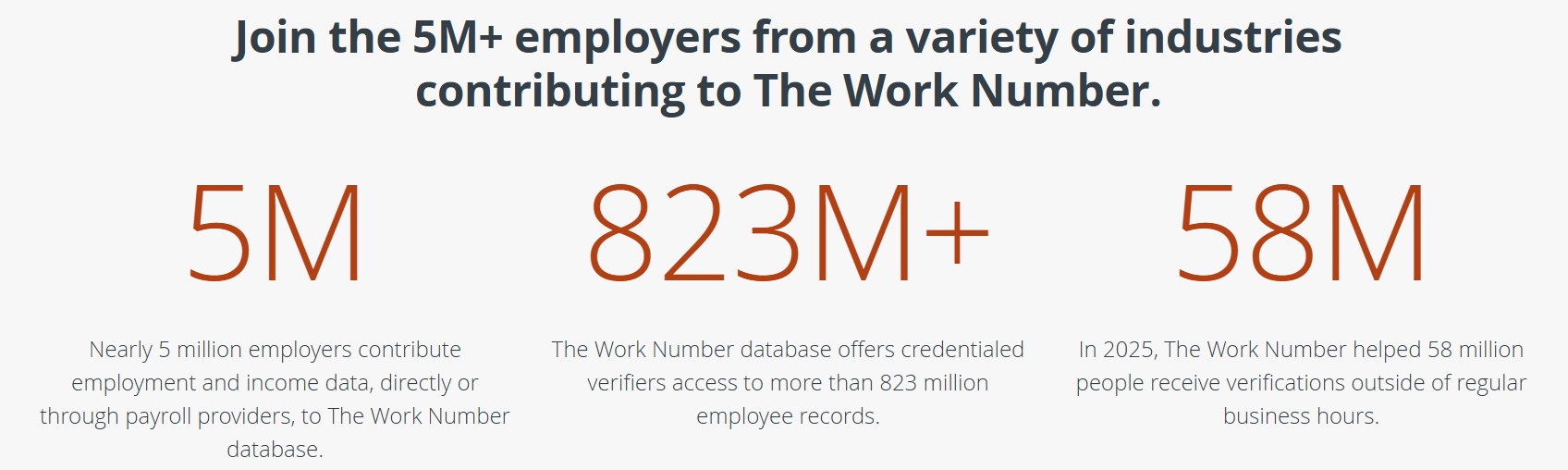
When a warehouse worker finishes their shift and logs in to a benefits application (such as SNAP), they have to prove they earn a certain amount. To do this, no one calls their boss or asks them to upload a payslip. Instead, a computer checks their credentials and, within seconds, delivers their credentials to the relevant agencies. This system is enabled by the fact that 5 million employers share this data regularly with Equifax. In 2025, Equifax delivered the required data to 58 million people outside normal office hours.
Equifax calls this database the ‘Work Number’. It holds more than 823 million pay records which have been sent in by ~5 million employers. It is used by mortgage lenders, landlords, and state agencies giving out food aid and health benefits. In 2024, The Work Number processed 149 million verifications, nearly 400,000 a day, supporting 6.4 million auto loan applicants, 4.5 million job candidates, and 25.5 million people seeking government benefits. When a platform functions at this scale and delivers critical information to its customers, it stops being a simple data provider and instead becomes the basic functional layer, without which its customers will struggle to run their business.
Equifax is better known for its credit bureau. But the employment database is the most important segment in the company and the core reason why Equifax functions as a tollbooth for the business run by its customers. And the customers are happy to pay the toll, as it accomplishes some very important but basic checks for them in seconds. They pay so little compared to the value they get that they don’t mind.
Equifax has fallen 36% from its 52-week high of $272 to $174. The market is pricing this as a cyclical company in a mortgage drawdown and pricing it as if the information services business is itself under threat from AI. This is a premature conclusion, at least as of now. In the coming years, Equifax’s free cash flow will inflect higher as it completes its technology spend ($3B multi year cloud build). A business that the market believes will be disrupted by AI is entering its best cash-generating years. This is the key dilemma in this story, and we will test it. While researching the stock, we found another risk that we thought was innocuous at first but is material to the thesis.
Welcome to Rebound Capital. We study beaten-down stocks and businesses that have made successful comebacks. Subscribe for free to join our growing community of 25,500+ subscribers and make sure you don’t miss our next briefing.
How Equifax makes money
The main segments within Equifax are the Workforce Solutions (~43% of revenue), USIS (~34%), and International (~23%).
These 3 segments share one thing in common. These are businesses built on proprietary data and function as the foundational data provider for their customers. USIS and International are bureau businesses, and Workforce Solutions is the leading provider of employment data in the US and is the crown jewel of Equifax’s business. Across the three, FY25 revenue was $6.07B, adjusted EPS $7.65, and free cash flow $1.13B.
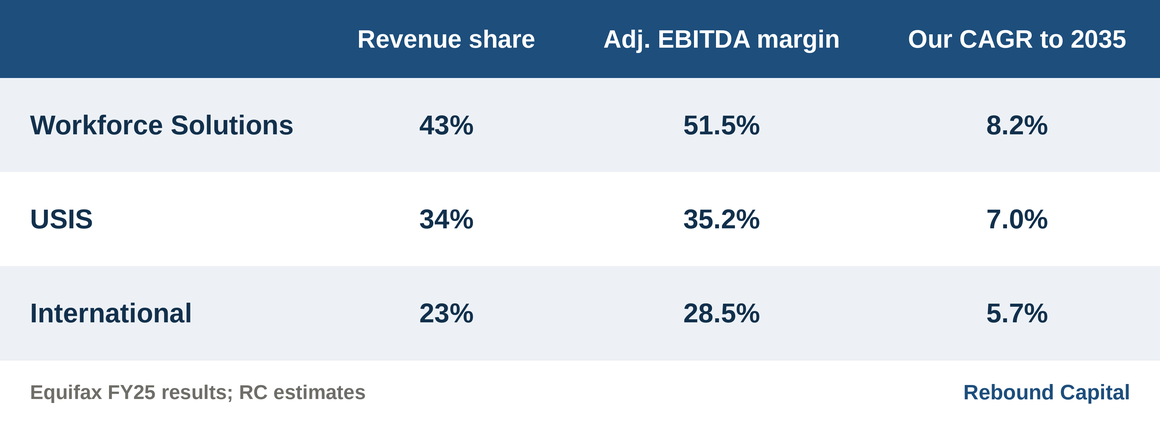
Workforce Solutions compounds fastest at more than 50% margins, which is why its share of revenue rises. The last column is from our base-case estimate.
Workforce Solutions: The best business within Equifax
Workforce Solutions made $2.58B in 2025 at an adjusted EBITDA margin above 50%. It is the biggest part of Equifax and by far the most profitable.
The mechanics are simple. Payroll systems send employee pay records to Equifax automatically, every pay cycle. When a lender, landlord or government agency needs to check what someone earns, it queries the database and gets an answer in seconds. Equifax charges a fee for each check.
So why would an employer hand over its payroll file for free? Because answering these requests is a chore it does not want. A large employer fields thousands of them a year, from mortgage lenders, landlords, benefit agencies and background screeners. Each one takes an HR person’s time, and there is legal risk attached if the answer is wrong or goes to the wrong party. Handing the file to Equifax once, automatically, makes the problem disappear. Equifax also runs related services for the same employers, such as managing unemployment claims and filing tax credits. The data is effectively the payment.
That is what makes this a two-sided network. Employers contribute because it saves them work. Verifiers pay because the answer is instant. Neither side has a reason to leave. The alternative for a verifier is to call or fax the HR department and wait two or three days, or use a smaller database that may not be cheaper and may not have complete or current data.
Workforce Solutions has 2 unequal segments. The first is Verification Services (84%), which is ~$2.2B in 2025 and consists of Mortgage, Diversified Markets (card, auto, personal, and direct-to-consumer), and Government. The fastest-growing part of this is government. When someone applies for Medicaid or SNAP, the agency has to verify their income, which is the same query a lender makes. Equifax signed roughly $300M of government contracts and renewals in H1 2026.
The other part is Employer Services at ~16% with ~$0.4B in 2025 revenue. This consists of talent screening, onboarding services, unemployment claims, and tax credits. Employer Services is expected to shrink in 2026 due to Congress not renewing the Work Opportunity Tax Credit (a US federal tax credit for employers who hire from targeted disadvantaged groups), which cost the segment a couple of points of growth.
The Moat: Workforce Solutions is a 2-sided data network. This is the deepest moat among Equifax's 3 divisions.
New competitors cannot offer the same breadth of service as Equifax as it does not have the scale of data. Also, in a 2 sided network like this, the problem faced by new competitors is that they have to onboard data providers and customers at the same time - and both of them have no incentive to shift away from Equifax (which has >823 million records). Equifax has a large number of automated data partnerships and integrations like the Workday partnership. Such partnerships are sticky once put in place.
The moat may be even deeper for a mortgage provider's workflow. Equifax has the requisite compliance and audit trails needed for such work. In fact, Equifax’s systems will be integrated into the loan-origination workflows. So if a lender has to switch, they will need to change their very processes.
Equifax has the strongest pricing power in this division, as can be inferred from the >50% adjusted EBITDA margins. In an antitrust complaint filed in 2024, the allegation was that the per-transaction pricing rose by ~270% between 2012 and 2024 (from $18 to $66). We will not comment on the merits of the case, but this does show pricing power.
USIS: the bureau everyone associates Equifax with
This segment holds the traditional US credit bureau. It made $2.08B in revenue in FY25 with a ~35% adjusted EBITDA margin. This segment provides data on consumers for consumer and commercial lending, along with the credit scores (either its own or 3rd party). Other products for decision-making, identity, and fraud prevention that lenders require are also part of this segment.
This segment also makes money by charging a certain fee for each data pull across mortgage, auto, card, personal, and commercial lending. USIS also resells the FICO score, computing it on its own file under license and remitting a royalty to FICO. We will come back to this mechanism as it explains the reason for lower margins in this segment.
The Moat: The key moat for this segment is regulatory. The US government has mandated that all conforming mortgage lending (loans sold to Fannie Mae and Freddie Mac) be done by pulling data from all 3 credit bureaus: Equifax, Experian, and TransUnion.
The way this system reinforces the moat is:
It is mandatory to pull data from all 3 bureaus on conforming loans, which makes the 3 companies complements rather than rivals. Worth noting that this is a regulatory choice, not a law of nature. The FHFA proposed dropping to two reports in 2022, shelved it in early 2025, and the current director has kept tri-merge in place. The industry is now pushing further. In December 2025, the Mortgage Bankers Association asked the FHFA to allow a single report for borrowers scoring above 700. We have modeled for a bi-merge scenario in the bear case [model shared at the end].
To pull bureau data, you have to give your own account data. In this way, a new entrant will not have any data to furnish, and hence lenders will not contribute to it, so building a competing file or data is extremely difficult.
FCRA (Fair Credit Reporting Act) compliance, ability to handle disputes, and years of regulatory compliance record and relationships are a deep moat.
The key factor to remember here is that since there are 3 players in the tri-merge mortgage file and since this system is maintained by regulatory action, there is little scope for continued pricing increases.
International
This is the credit bureau and data business running internationally. This includes Canada, Brazil via Boa Vista, Argentina, Chile, Europe (UK, Spain, Portugal, Ireland), and Australia, New Zealand, India.
This segment made ~$1.41B in FY25 with 28.5% adj. EBITDA margins. Latin America is the key growth driver here. This segment has the weakest moats of the 3 segments. In some markets, Equifax is in a good position, and in others it's weaker. Equifax is strong in parts of Latin America, behind Experian in the UK and in India, and in a duopoly with TransUnion in Canada. We model this segment to grow at 5%-6% CAGR till 2035.
Our thesis: A mix shift towards Workforce Solutions
Workforce Solutions has the strongest moat amongst Equifax’s segments. We would classify both Workforce Solutions and USIS as basic infrastructure, and hence these 2 segments have the deepest moat.
In our model, we expect the share of revenue from Workforce Solutions to rise to ~46% in 2035 vs. ~43% in 2025. So the company’s most important and defensible division is expected to increase its share of the total revenue. This is a major shift and the core of our thesis on Equifax. This is also the answer to the question we opened with. The mix shift will drive the margins higher, and this will in turn drive the cash flow inflection (coupled with the technology build getting complete).
What went wrong?
Multiple factors came together leading to Equifax’s ~36% drawdown since its 52-week high.
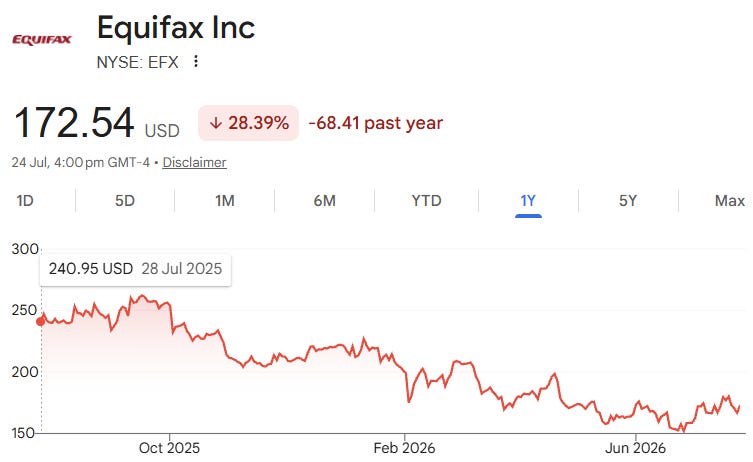
EFX entered 2025 at north of 30x earnings and was priced as a compounder. This premium multiple was challenged as the business’s positive catalysts got deferred.
The expected mortgage recovery has been deferred due to multiple issues one after the other. Compounding this was the fact that information services companies have been de-rated by the market due to worries about the effect of AI.
The Q2 results on 21st July beat on EPS while revenue was in line. But the Q3 guidance was short. This caused the stock to fall ~12% that day, on fears that the mortgage market has not troughed.
On 2nd October 2025, Equifax fell ~8% after FICO launched its Mortgage Direct License Program. This let the tri-merge resellers license FICO’s algorithm directly and compute the scores themselves on bureau data. This replaced the previous system where each bureau, including Equifax, would give its data along with the computed FICO score (after paying a royalty to FICO) and give this file to the tri-merge resellers.
The data still comes from Equifax and the bureaus, but this was a direct hit. The revenue that disappears is the difference between FICO’s royalty and the price at which the file was being sold. Analysts put the earnings hit to bureaus at 10%-15%. It is a real attack on the USIS revenue line. But the defense is that the bureaus can still reprice their data.
The key reasons for the drawdown are driven mostly by sentiment, plus slowing revenue growth for Equifax. The business continues to perform, though, with Q2 revenue growth of 7% YoY (ex FICO royalty dynamics) and EPS growth of 13% YoY. FY25 free cash flow generation was $1.13B. The multiple derating drove the price decline. This is an interesting setup for us as we think the business still has decent runway to grow in the coming years.
The Bureaus and FICO: From partners to competitors
The credit bureau business inside Equifax gets the most attention but matters less than the Workforce Solutions segment. It is worth understanding anyway, because it explains why the reported margins look worse than the business is.
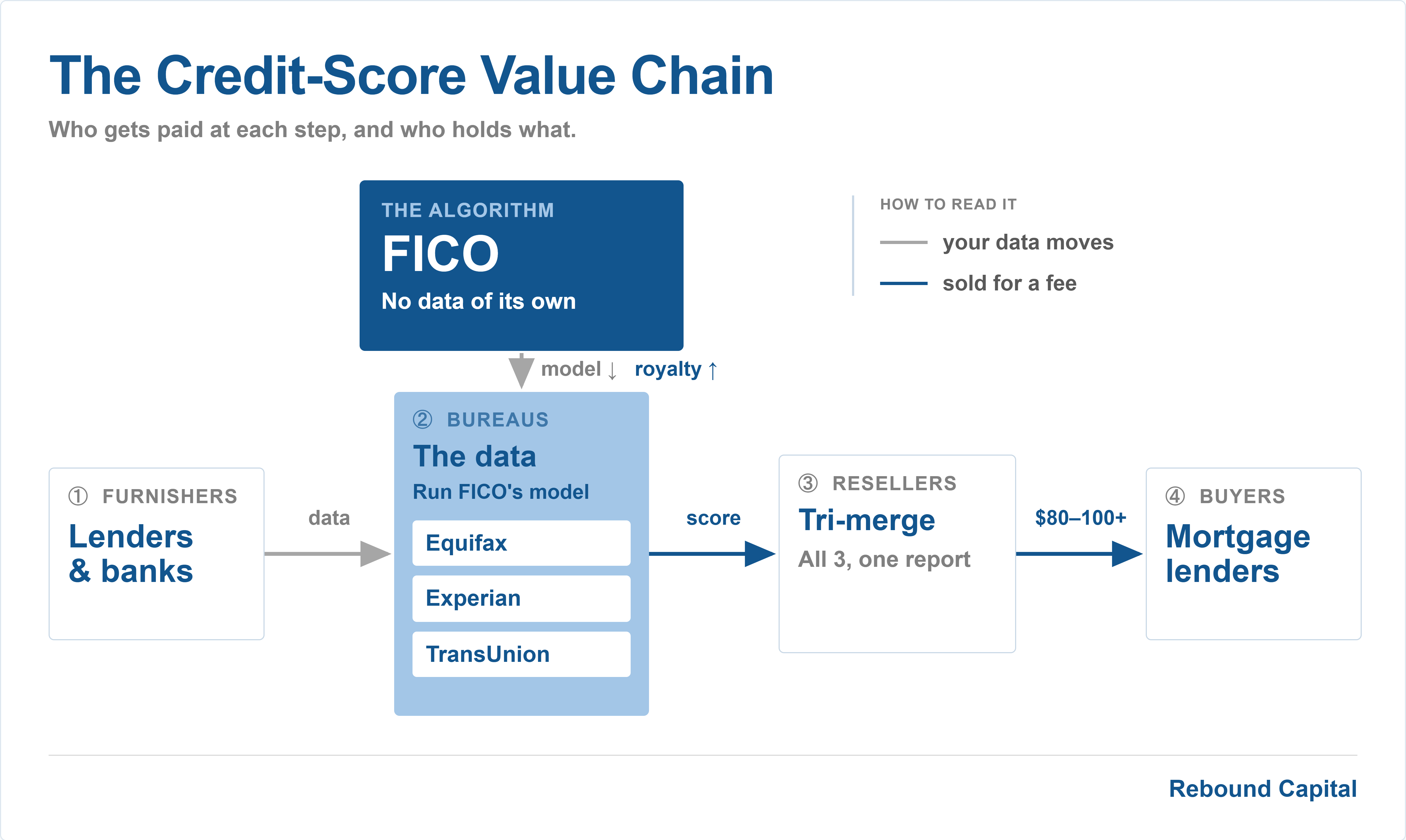
The above chart shows how the bureaus and FICO interact with each other. When a financial institution orders a tri-merge report, it does so from a reseller. This reseller is a company that buys the bureau data from Equifax, Experian, and TransUnion (they have to buy all 3). Each bureau has already computed a FICO score on its data for the customer and then handed the file to the reseller (with their markup). The bureaus directly pay the FICO royalty.
The History: For decades, Classic FICO was the only score Fannie Mae and Freddie Mac were allowed to accept on a loan. This was an unusual situation where the regulator had handed a monopoly to a private company (FICO). Congress tried to end it in 2018, but for ~7 years nothing happened.
This changed when FICO raised prices by ~16x, from $0.60 per score in 2018 to ~$10 in 2026. This led to political pressure to allow a second score. The result was that VantageScore, jointly owned by the 3 bureaus, was allowed to be accepted by both Fannie and Freddie.
Why does it matter to our thesis: The first is margin optics. Equifax books the full FICO fee as revenue, then pays it straight to FICO. When FICO raises the royalty, the revenue goes up while the profit does not. This leads to a lower margin. This is just optics. That is why USIS adjusted EBITDA margins fell to 32.8% from 35.0% YoY in the latest quarter. Nothing about the business changed.
The second is that the bureaus own VantageScore. Every FICO score replaced by a VantageScore removes a royalty payment. Equifax’s 2026 guidance assumes 100% FICO scores, and the CEO said that as mortgage customers convert to the lower-priced Vantage scores, the company expects significant margin expansion. Revenue down, margin up. So both the USIS revenue and margin growth rates have nuances in them that an investor must be conscious of.
VantageScore adoption: VantageScore is already widely used outside mortgage, with ~42 billion scores pulled in 2024. Adoption in mortgage has been slow, and will stay slow. Classic FICO is wired into MBS pricing and investor risk models, and investors price VantageScore-backed paper as higher risk. Management has sized the profit opportunity at $100M-$200M.
From partners to competitors: For 30 years, this was a partnership. FICO built the score, the bureaus held the data, and both coexisted. Then FICO wanted more: it increased royalties by sixteenfold and created a direct-licensing program that cut out the bureaus' markup entirely. The bureaus answered with a rival score. Neither side can walk away. FICO needs the data from the bureaus and the bureaus’ own score is not as trusted by the market as the FICO score. The bureaus have a slight upper hand in the medium term (if VS adoption picks up).
The Compounding Opportunity
A few things compound here. The revenue mix moves toward the highest-margin segment, which lifts consolidated margins. And with the technology build finished, those margins now generate free cash instead of funding capex.
We expect EFX’s free cash flow to inflect in the coming years. Free cash flow was $866m in 2021, collapsed to $133m in 2022 at the peak of the cloud build, then recovered to $516m, $813m and $1.13bn in 2025. These are reported figures. In the model, we deduct stock compensation, which takes 2025 to $1.06bn. Capital intensity should now normalize to ~7% of revenue. This heavy spending on technology was the key reason Equifax was not generating cash in the last few years.
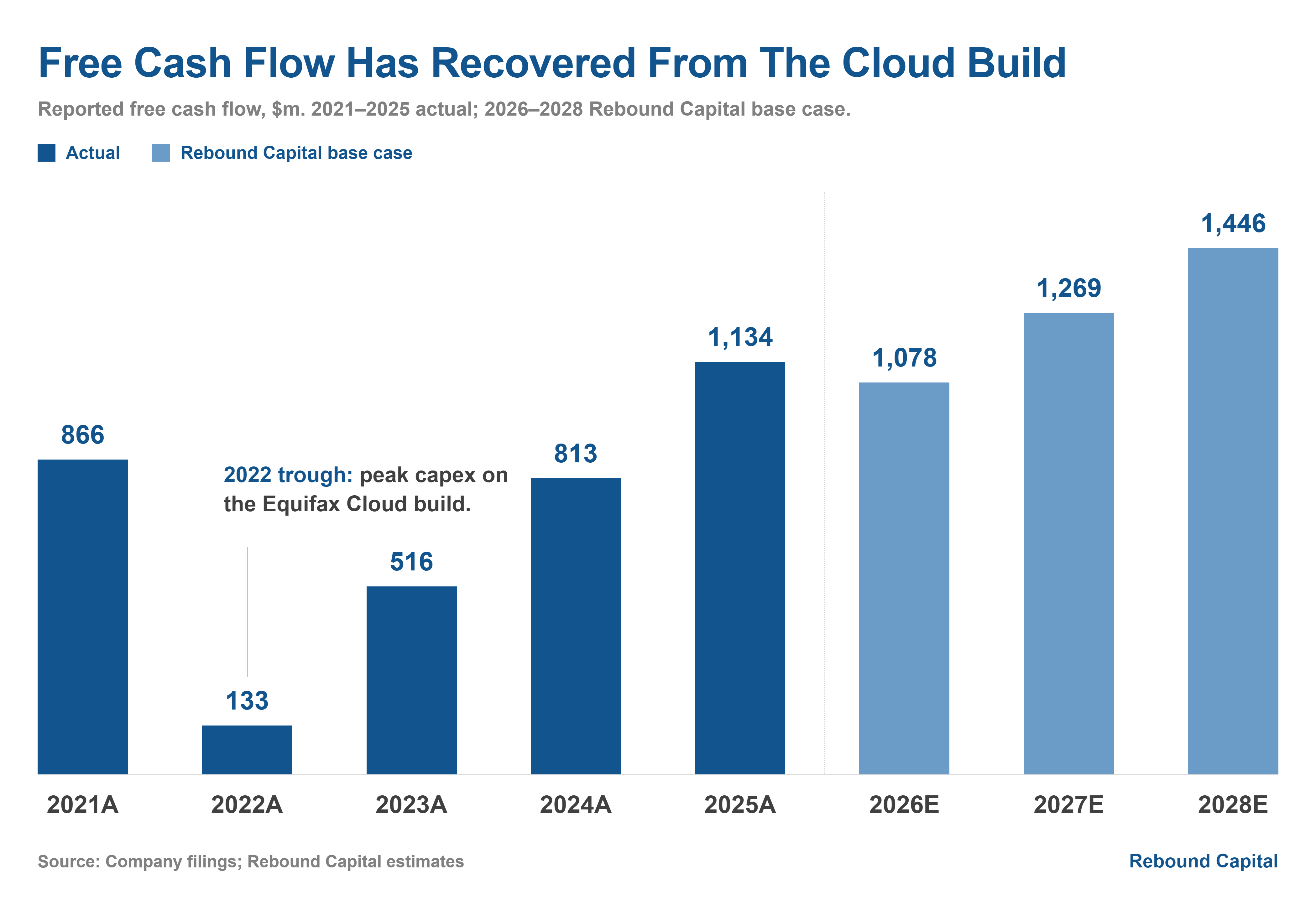
The mix shift described above does most of this work. Consolidated EBITDA margins will move towards ~38% from the current ~32%. We expect that EFX can compound revenue and FCF at ~7% and ~10% CAGR in the coming decade.
Capital returns will be another important driver of returns. In H1’26, the company purchased $560M of shares, with roughly $1.5B of authorization remaining. EFX is currently at ~25x EV/FCF, which means they can keep reducing up to ~3% of shares every year. At current low prices, this is a source of marginal buying and adds ~3% CAGR to our expected return.
Mortgage Recovery as a coiled spring: Mortgage originations were $4.4T in 2021, $1.6T in 2023, and expected to be ~$2.2T in 2026 (MBA forecast). The company is forecasting $2T. The key reason for this lower level of originations is that interest rates have repriced materially in the last 5 years. Roughly 75% of loans are priced under 6% so moving means repricing the largest expense for a household. Another reason is the historic unaffordability of housing. We expect that this lull in mortgage originations cannot go on indefinitely. There are roughly 860,000 new households formed a year on Harvard's projections, and sooner or later they need somewhere to live. When the market recovers, we expect the USIS division to benefit directly.
In our base case, we are not embedding a mortgage recovery. It is an optionality.
Does AI break the business? Can startups disrupt it?
The market fears that AI makes information businesses less valuable. This may not play out. A model can think about things, but it cannot manufacture a payroll record an employee did not send. The barrier here is permission and access. It is not intelligence. Also, with the advent of LLMs, companies with proprietary data are well positioned to monetize it in multiple ways. We expect Equifax to increase the share of revenue from new products and services. The company tracks this metric as the Vitality Index. It is currently at 16% (so 16% of current revenue is from newer products). This is higher than the ~10% goal set by the company. This metric is important as a company innovating for its customers and having critical proprietary data is unlikely to be disrupted.
Another fear is that as AI drives white-collar job losses, what happens to the usage of the Work Number? This is again not a direct threat, as the Work Number is used for lending decisions and benefit eligibility and not for hiring. The hiring-sensitive services are talent screening and onboarding, which make up ~16% of the segment’s revenue. So the risk is capped here as well. Also, unemployment claims can be expected to rise with rising layoffs. Government verification is the bigger offset. Job losses mean more benefit applications, and each one needs an income check.
In any case, this assumes AI will lead to job losses, which hasn’t played out yet.
Disruption threat from startups
Argyle, Truv, and Truework attack verification by asking the borrower to log into their own payroll account. Argyle markets itself at up to 80% below a legacy report, and Argyle and Truv are now GSE (Fannie & Freddie) accredited. These startups have been around for more than 5-6 years and, to date, have not been able to dent Equifax much and are still subscale. The reason is structural. Equifax already has the data, so a lender types in a name and gets an answer instantly. The startups have to wait for the borrower to log in, and many never do. So lenders use both: Equifax first, and a startup only for the applications Equifax cannot answer. That leaves the challengers with whatever is left over. Industry estimates put Equifax's instant hit rate on mortgage files at 60% to 70%. EFX also carries FCRA certification and an audit trail a lender can defend in an examination. The startups win where Equifax cannot answer: gig workers, thin files, and price-sensitive buyers like benefit agencies and tenant screeners. The competitor that should worry a shareholder is Experian, which collects payroll data the same way Equifax does and has the balance sheet to keep going.
So neither AI nor the startups break this business. There is another less cited threat that we are tracking.
Legal and Regulatory Threat
Equifax is facing a regulatory threat on its strong access to payroll data from ADP, Paychex, and other payroll processors. The way these multi-year deals and access are structured makes it more expensive to get this data from anywhere else. That is why the startups have to ask customers to log into their payroll database. The threat to this moat is coming from courts. 2 mortgage brokerages sued Equifax in 2024. Their argument is that exclusive deals give it control of >40% of the payroll data anyone needs to verify income electronically, and that it used that position to raise the price of a verification from about $18 in 2012 to about $66 in 2024. Equifax asked the judge to dismiss the case and was refused in February 2025. It then tried to move the dispute out of court and into private arbitration, and was refused again in February 2026, with the court holding that Equifax had waited too long and given up that right.
The remedy was already imposed in December 2025 in Australia. Equifax entered into a binding agreement with the regulator not to sign new agreements that would block rivals from accessing payroll data. This is the obvious thing a US court would ask for. This is not the first time. The FTC put a ten-year consent order on this business in 2008, limiting its acquisitions of verification competitors. That order expired in 2018, and since 2021 Equifax has completed 14 acquisitions, a third of them in Workforce Solutions.
Separately, senators opened an investigation in Feb’26 into Equifax profiting from Medicaid and SNAP work requirements, which is the fastest-growing part of Workforce Solutions. So the threat is legal and regulatory. Losing exclusivity would not kill The Work Number, as 5 million employers and the largest set of records do not disappear, but it turns a monopoly into a scale advantage, which changes what the business is worth long term.
We modeled this risk. The exclusivity remedy and bi-merge together only cost ~11% of revenue by 2035, but we expect a much larger effect due to the lower margins Equifax would be able to charge if the Work Number is disrupted. That combination is what produces our bear case.