
Deep Dive: Palantir ($PLTR)
Can their moat be disrupted?

On June 30, 2026, at a conference hall in Washington, Amazon Web Services committed $1 billion to a business model invented by Palantir. The idea was to start sending its own engineers to sit inside customer companies for weeks at a time, building AI into how those companies run. AWS called it forward deployed engineering. It is the approach Palantir pioneered more than a decade ago, a fact nearly every account of the announcement noted.
On the 2nd of July, Microsoft went even bigger: it committed $2.5 billion and 6,000 engineers to embed with customers.
In May, Anthropic and OpenAI had done the same. They raised billions for a near-identical venture. The labs had decided they wanted to be Palantir on top of an LLM lab.
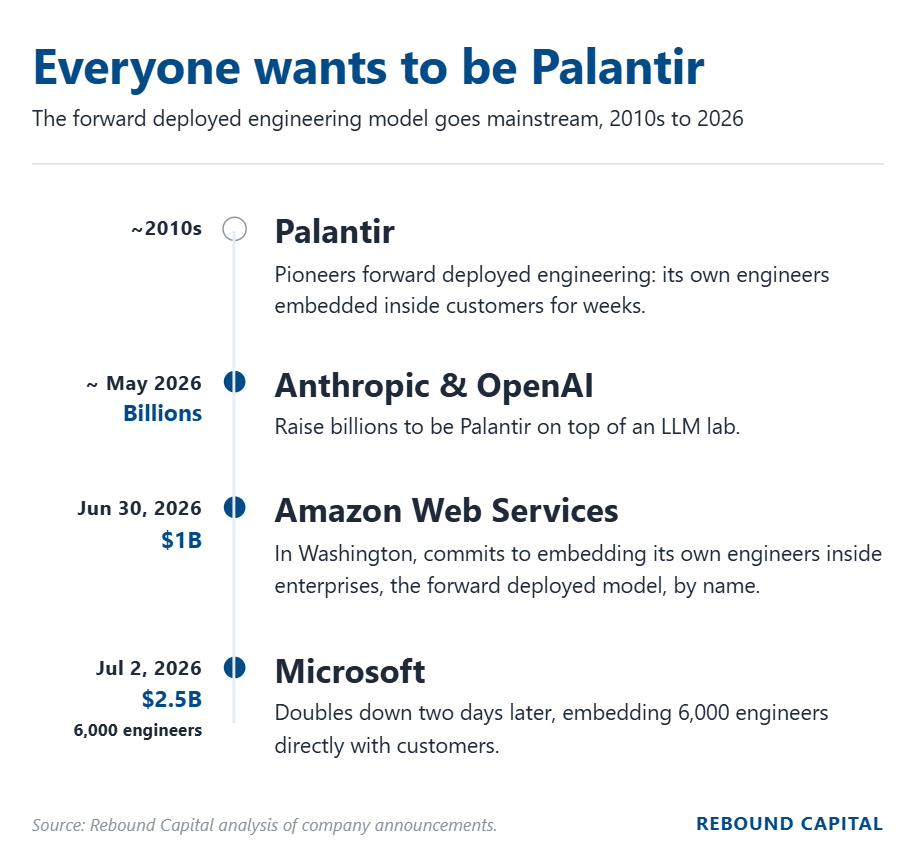
That is a strange compliment, and the most important development for anyone valuing Palantir today. The thing that made it special, the willingness to do the hard, unglamorous work of putting software/AI to work inside a real organization, is being copied at scale by the richest companies in technology.
So, what is a forward-deployed engineer?
A Forward Deployed Engineer (FDE) is a software engineer who embeds directly inside a customer's environment to solve that customer's specific operational problems. They then feed what they learn in the field back into the core product. Unlike a traditional engineer who builds one capability for many customers, an FDE builds many capabilities for a single customer.
Note: Scroll down to the bottom to see our latest portfolio update.
Welcome to Rebound Capital. We study beaten-down stocks and businesses that have made successful comebacks. Subscribe for free to join our growing community of 22,500+ subscribers and make sure you don’t miss our next briefing.
How Palantir makes money
Palantir was founded in 2003 by a group that included Peter Thiel and Alex Karp and was seeded by In-Q-Tel, the CIA’s venture arm. Its first product, Gotham, was built with intelligence agencies to consolidate scattered, siloed data into a platform that analysts could act on. For most of the next two decades, the company lost money, roughly $6bn in cumulative losses, because the work of installing and customizing the software was expensive and each early contract was small.
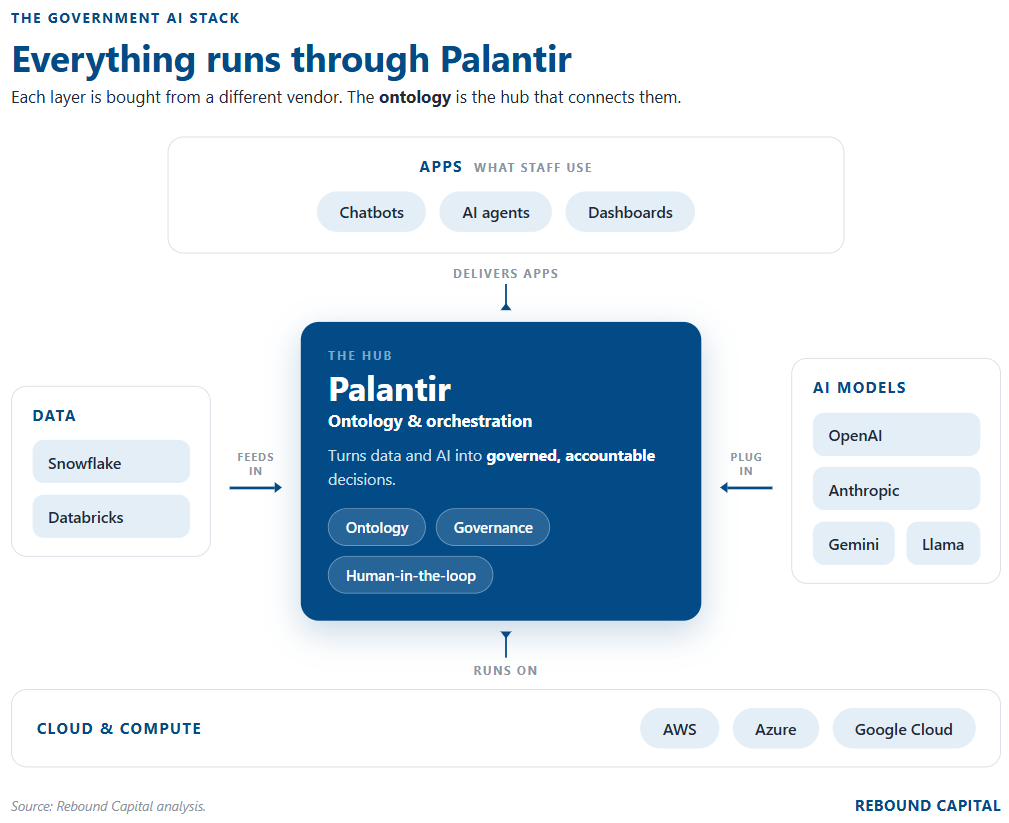
Palantir has 4 major products today:
Gotham remains the operating system for defense and intelligence.
Foundry is the operating system for enterprise data used by large businesses. This is the key growth engine (as government contracts are lumpy and can be renegotiated on a whim).
Apollo installs and continuously updates the software across cloud, on-premise, classified, and edge environments.
AIP (Artificial Intelligence Platform), launched in 2023, is the layer that integrates third-party large language models into Foundry and Gotham, enabling customers to run AI agents on their own governed data.
Tying all four together is what Palantir calls the ontology. It’s a map of your business. It turns a row in a spreadsheet into the actual customer it stands for, links that customer to their orders and shipments, and lets software and AI agents act on those connections instead of just reading numbers. This is the layer Palantir says is its moat.
Palantir sells these platforms on multi-year contracts, with forward-deployed engineers who embed with the customer. It reports revenue in two ways: by customer type (commercial or government) and by geography (US or international). Government is a handful of very large, contract-driven relationships. Commercial is a land and expand model across many smaller accounts, and since 2023 it has been the growth engine.
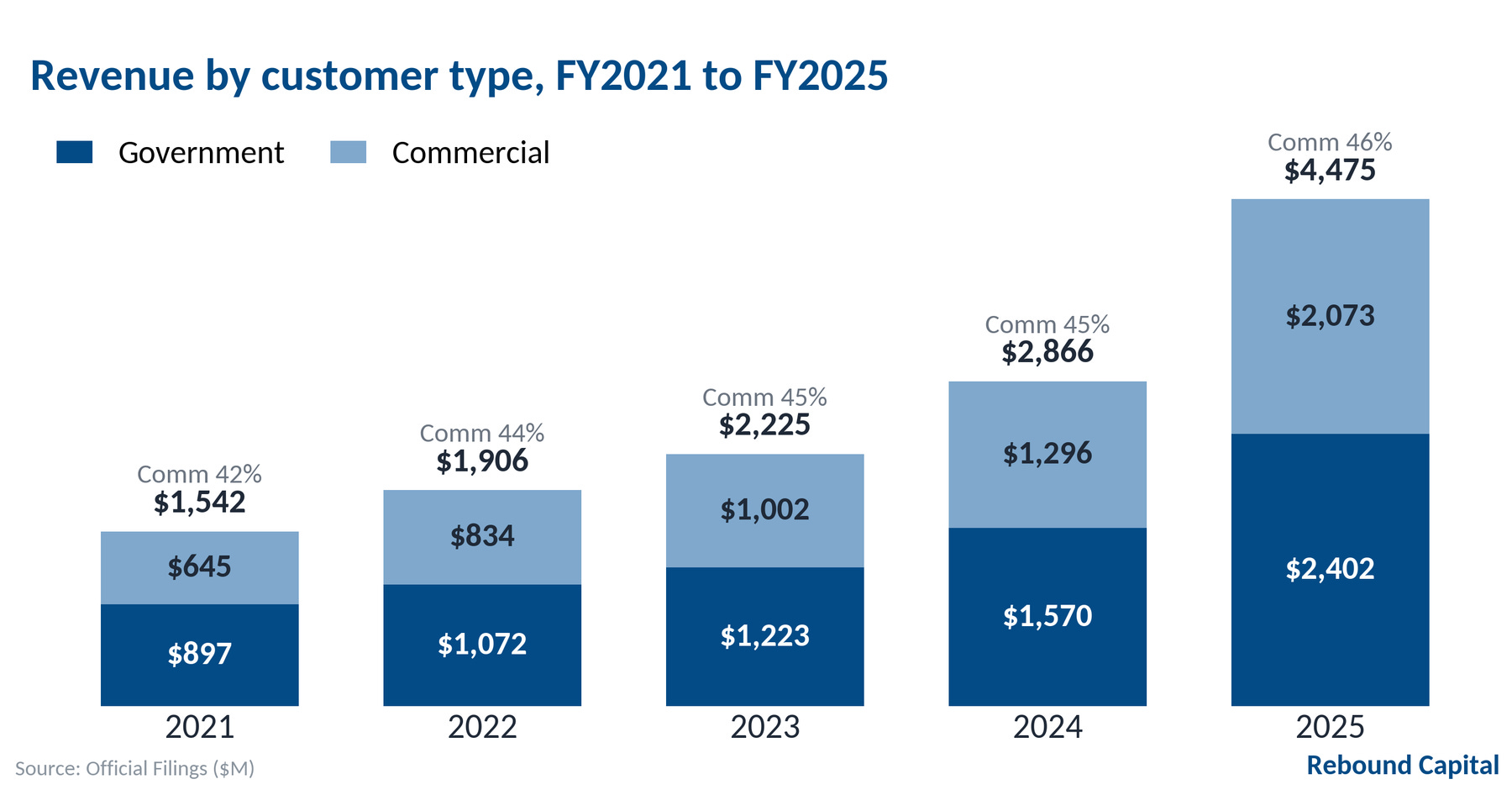
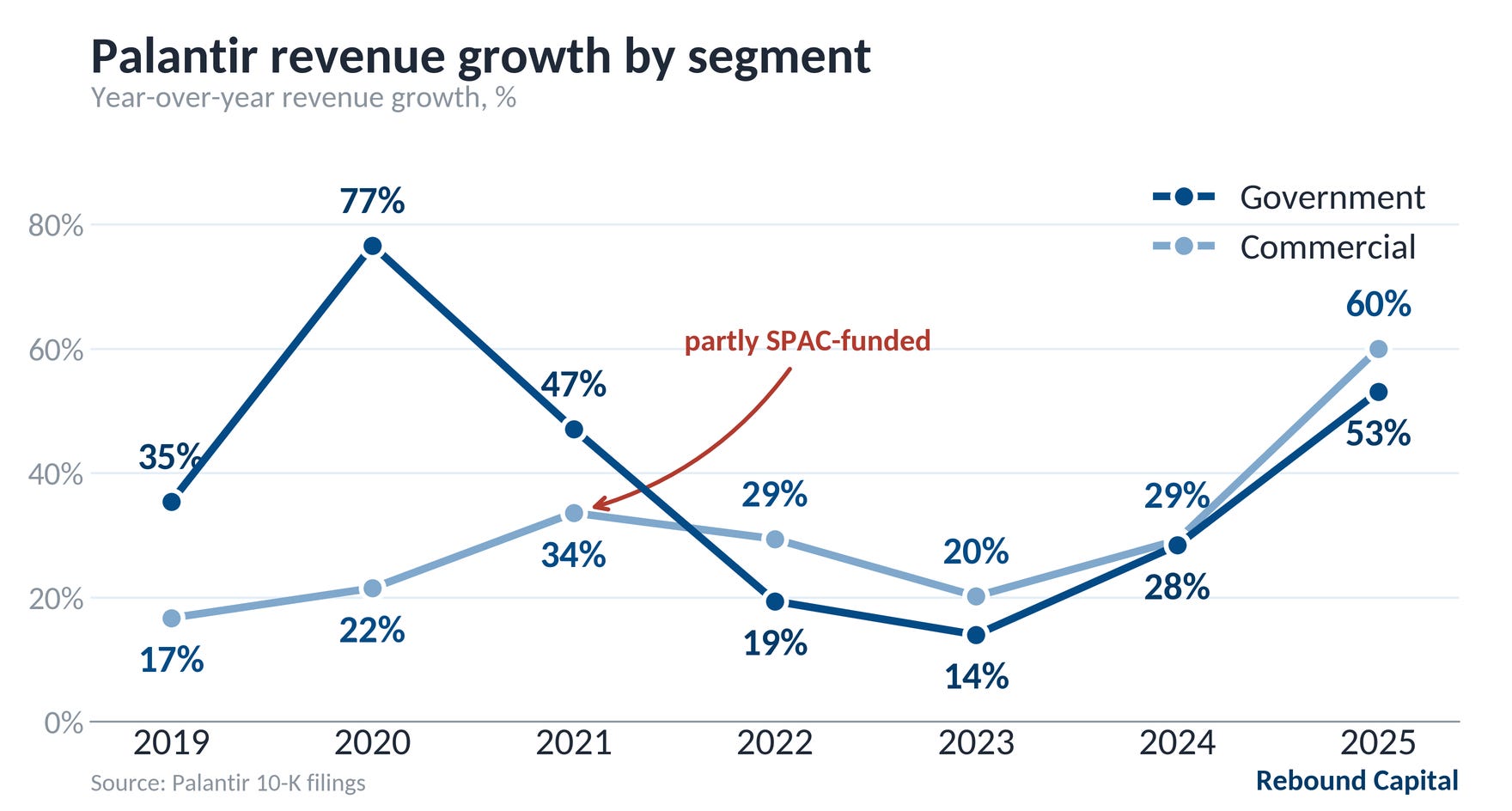
The picture over 5 years is a company rebalancing. Total revenue nearly tripled, from $1.5bn in 2021 to $4.5bn in 2025. Government, once 58% of revenue, has drifted to 54% because commercial growth has outpaced it. In 2025, commercial revenue grew by 60%, compared with the government’s 53%. The market’s attention now rests on the commercial line. This is the segment where Palantir faces more competition, but it is the larger, higher-margin TAM.
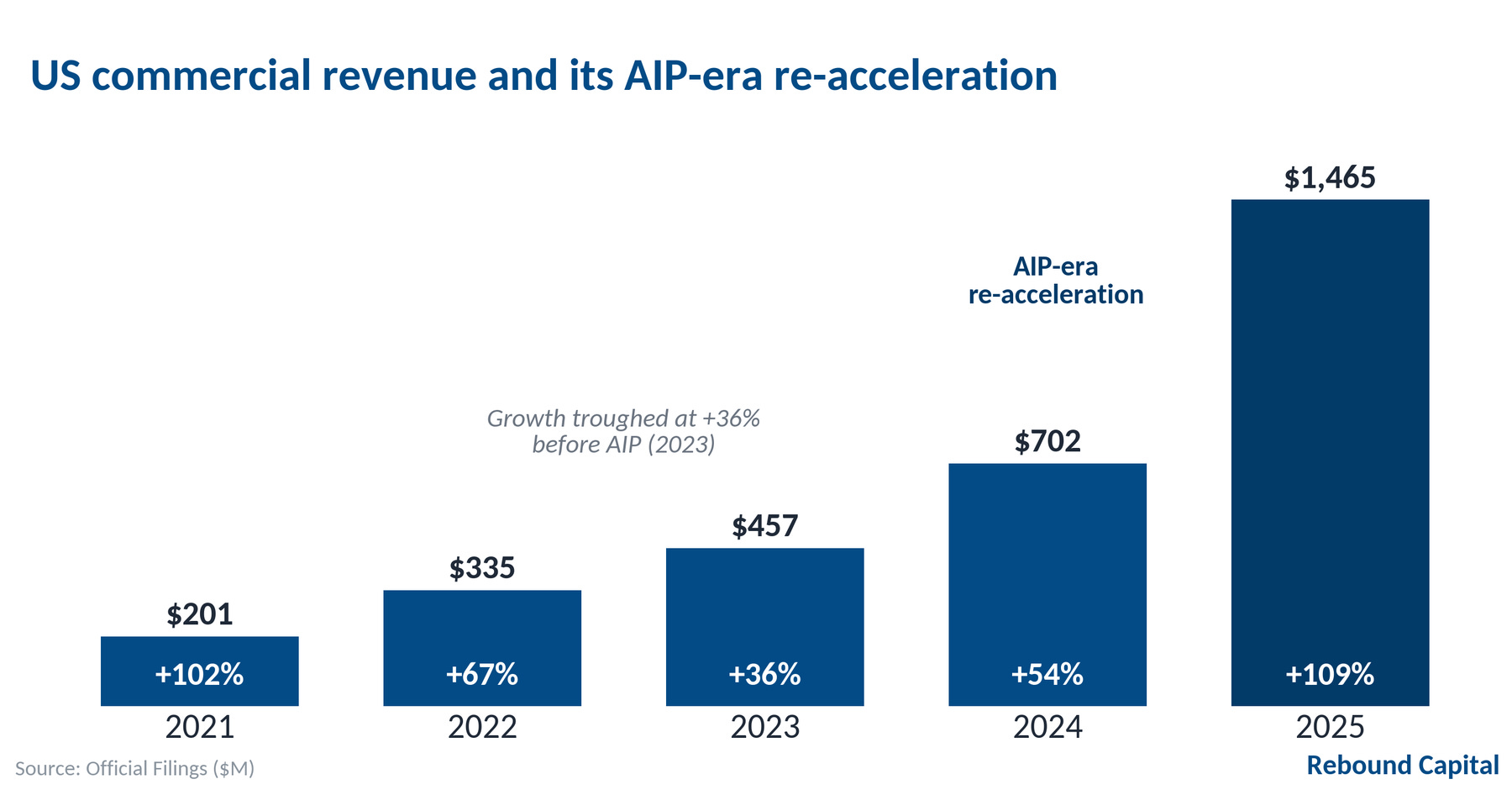
Zoom into US commercial, the heart of the story, and AI’s effect is unmistakable. It grew more than sevenfold from 2021, but the path was not smooth: growth decelerated to just 36% in 2023, the year before AIP, then re-accelerated to well over 100% by 2025 as demo boot camps pulled in new companies. That surge is concentrated in the United States. International commercial revenue grew only about 2% in FY2025, even as international government, the relationship-driven piece, grew 47%.
But Palantir is more like a consulting business than a SaaS. If this were a usual software business, the gap between US and European commercial growth would not be so large. But Palantir’s business is high-touch. Forward-deployed relationships that exist in the US and not in Europe (Palantir’s own chief executive conceded the point, calling the European problem a matter of bandwidth) are a consultancy’s constraint, not a software company’s. This matters, as we will discuss in the following paragraphs (consulting businesses usually receive lower valuations than SaaS).
Why is it down?
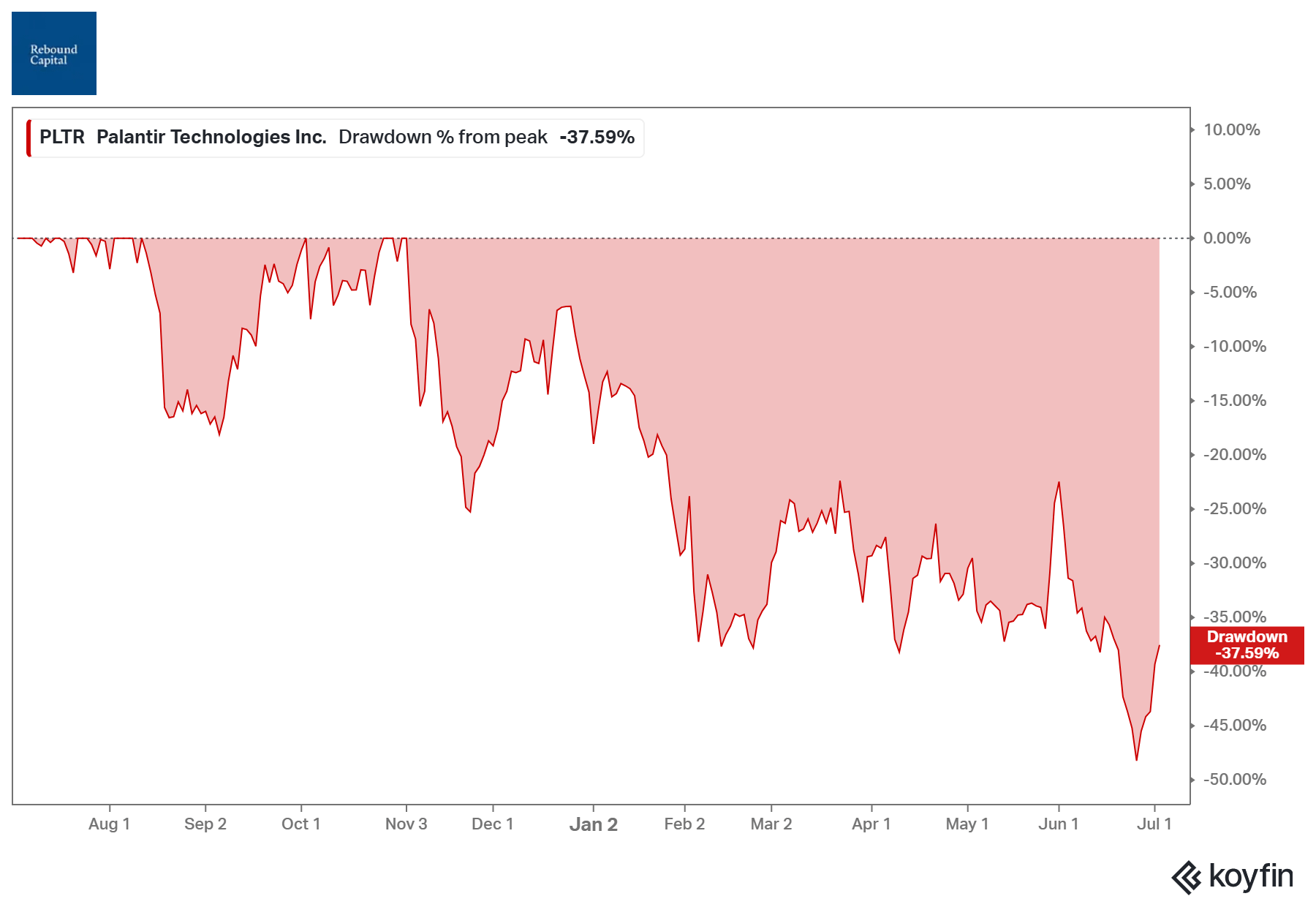
Palantir peaked at ~$207 in November 2025 after a sharp rise, then fell roughly 50% to briefly touch $106 in late June, before rebounding on the NVIDIA partnership:
SaaS derating: The market is rotating out of expensive software amid fears that AI-driven coding will disrupt software moats.
Increasing competition: as we will argue, many large and prominent firms are coming for Palantir’s market. What Palantir offers, ontology, is now table stakes for all large AI deals.
Nosebleed valuations: Palantir traded at a >200 NTM PE ratio at its peak. This has now moderated to ~80x NTM PE ratio (GAAP), but is still very expensive.
Competition: the enterprise AI market is getting crowded
Before the AI era, Palantir's commercial segment was not growing as fast as the headline numbers imply. There are a few red flags for us.
In 2021, the company put $405.5 million (per RBC) into nearly two dozen startups that were then going public via SPACs, which promptly signed on as customers. Management conceded the revenue was small, about 2% of its first nine months' sales, but Citi's Tyler Radke found that the headline commercial growth appeared to jump to 37% year over year in Q3 2021, while once you strip out the SPAC revenue it had slipped to ~22%, from ~25% a quarter earlier.
Palantir wound down the program in 2022, reportedly booking ~$300 million in losses as the SPAC shares collapsed.
Palantir’s differentiator was never the software. It was a business-model choice that everyone else found unappealing: send elite engineers to camp inside a customer's organization for months and wire AI into the workflow. The forward deployed model was the moat, and big-tech did not care much for it. It worked for a decade because no one with real scale wanted to copy it. In the last two months, that has changed.
The threat is that these giants can afford to give away deployment work because each earns its money on a different layer, whereas Palantir cannot. Deployment is the product Palantir sells.
Amazon earns through the cloud. Every system its engineers build runs on Amazon’s servers long after they leave, so it can treat the work as a near free way to sell more computing. And its offer beats old-style consulting. It can build the system within the customer’s own cloud in weeks, hand over working software plus staff trained to run it, and charge for a business result and not billable hours.
The labs sell the AI models. Every Palantir AI deployment that runs on a model from OpenAI or Anthropic means Palantir is really just a middleman marking up their work (and making >40% operating margins). They would rather cut out the middleman, do the deployment themselves, and keep the full margin, rather than hand a slice to Palantir. And they have an easy way in; their consulting ventures are backed by private-equity firms whose own companies become the first customers, so the sale arrives as an introduction from the owner.
Microsoft's advantage is distribution. It already has enterprise contracts with nearly every large company, and it wants those companies to spend more on its cloud and AI tools, so running their deployments is a way to pull more of that spend onto its own platform. Its edge is that it meets companies where they are, plugging into the software and data they already use rather than asking them to rebuild everything in a separate proprietary system, as Palantir's platform does.
The founder’s own behavior is a tell
Through 2026, Palantir’s chief executive has spent his airtime attacking the LLM labs. A CEO will only do this if he fears disruption from a particular company.
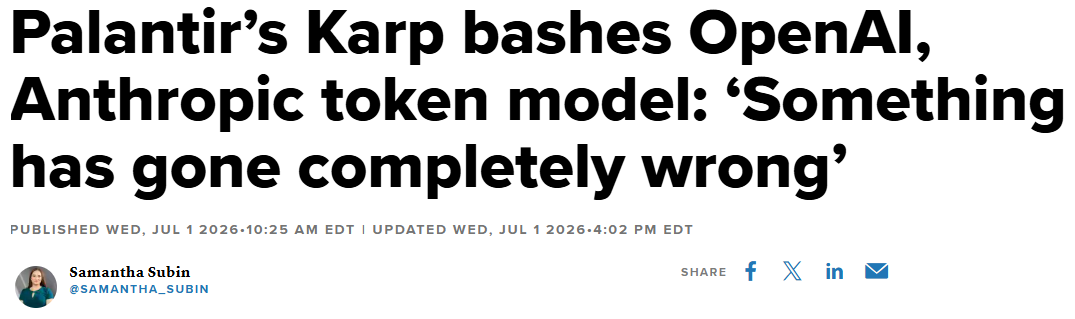
Recently, he called raw model quality ‘commodity cognition’ and said that companies using frontier models are furious about ‘paying for tokens that create no value’ while handing their edge to the model providers.
The LLM labs own the models inside many Palantir deployments, which makes Palantir a middleman reselling their work. Now they want to handle the deployment themselves. This is a direct swipe at Palantir.
The NVIDIA deal, allowing customers to keep their own model weights in-house, is a defensive move to prevent value from migrating away from Palantir (and NVIDIA!).
Commoditization from below: the warehouses close the gap
Another threat comes from data warehousing companies like Snowflake and Databricks. Palantir’s pitch is that raw warehouse data is inert and needs its ontology to become AI-ready. The warehouses are now building that layer themselves, on open formats, so a company gets a governed, AI-ready data layer inside the platform it already owns, with no separate system to buy and no lock-in.
This is not incremental. At its June 2026 summit, Databricks launched Genie Ontology, and its CEO told the room that AI does not have an intelligence problem; it has a context problem. That is Databricks attacking the semantic layer that Palantir calls its moat. Snowflake is doing the same.
Neither company will field a forward-deployed army, and many Foundry deployments still run on top of them. But they don’t need to. They only have to make the separate operating system look redundant or less important. It only has to make a premium layer look like a nice-to-have. For a bank whose data already sits on one of these platforms, that is the gap between months spent integrating with Foundry and weeks spent switching on the warehouse's own agent tooling.
The government business’s sovereignty ceiling
Management blames flat international commercial revenue (up ~2% in 2025) on ‘bandwidth,’ relationships built at home and not yet abroad. We read it the other way. Europe has looked at Palantir’s offering and, increasingly, said no.
The reason is legal, and hiring will not fix it. As a US-incorporated company, Palantir is subject to the US CLOUD Act, which can compel it to produce data wherever it sits, and no contract overrides US federal law. For a government to route citizen data through Palantir is unacceptable. With the trans-Atlantic relationship changing, a reversal seems implausible.
Swiss agencies rejected Palantir at least nine times over seven years on that exact concern, and a Zurich court in June 2026 threw out 22 of its 23 counterstatement requests against the reporting. Germany’s military excluded it. In the UK, its largest European market, lawmakers want the NHS to drop it, and the BMA, representing 190,000 doctors, has called for a complete break.
In June 2026, France said it would migrate from Palantir to the domestic firm ChapsVision over the coming years, framing the move as a break from 'strategic dependencies.'
The best counterargument
The best counterargument is that hyperscalers have tried and failed to disrupt most SaaS businesses. For example, AWS built CloudWatch to take on Datadog, DocumentDB to take on MongoDB, and Redshift to take on Snowflake. All 3 products thrived despite the competition. So why would Palantir be disrupted?
We would argue that previously the hyperscalers went after SaaS products. This time, they are disrupting the delivery model. On top of that, this time, Palantir is dependent on companies trying to disrupt it. The labs own the models sitting inside AIP, and Microsoft owns the enterprise agreement the deal gets bought through. Palantir also needs cloud services from the hyperscalers to run.
Many companies that beat their clones still trade 50 to 70% below their 2021 peaks. Surviving competition doesn’t protect from multiple contractions. Palantir trades at ~80x NTM PE ratio! Even if Palantir can fend off competition, how can an investor earn a decent return by buying it at such a high valuation?
If deployment is low-margin, how does Palantir achieve software margins?
A recent deal reveals how the market values the forward deployed engineering model. OpenAI reportedly guaranteed investors in its deployment company a 17.5% annual return. You guarantee a return floor for capital-intensive, lower-margin businesses, such as infrastructure or lending, not for high-margin software, which attracts capital for its uncapped upside. This 17.5% guarantee is evidence that this is more of a service-based business model. The smartest capital in the world is pricing AI deployment as low-margin work (not recurring SaaS).
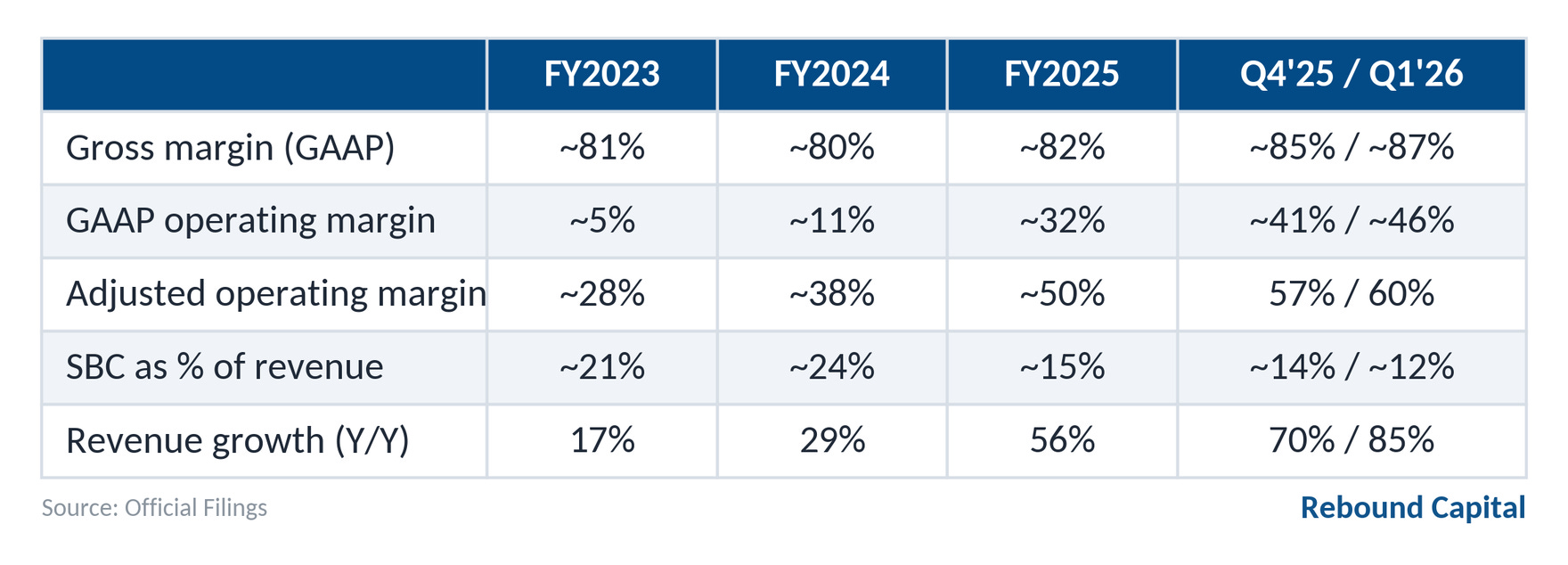
Yet Palantir posts an 88% adjusted gross margin and a 60% adjusted operating margin. The key here is that Palantir counts certain expenses in its R&D, Sales & Marketing and other expense lines - which should ideally be counted as cost of revenue. This difference matters. A service-based business model should not be priced at a premium to the market - least of all at ~80x forward earnings. For reference, Accenture trades at an 11x PE ratio. Palantir is a more capable organization and is growing much faster, but the valuation gap remains too large to ignore. And just as Accenture is being disrupted, Palantir faces the same risk, albeit at a lower intensity.
A few pointers about Palantir’s high margins:
First, the work becomes cheaper as it is repeated. Palantir spends heavily up front to win and build out an account, then earns years of high-margin add-on revenue on top of what it already built, so that early cost spreads thin over time. GAAP operating margin roughly doubled in a single year - from about 20% to 46% (Q1 2025 to Q1 2026), and that is the effect showing up. The catch is that this only works while Palantir is the one everyone pays for the deployment. Once rivals can do the same work, that add-on revenue will have to be offered at a lower price.
Cost classification: A share of forward-deployed engineering costs is shown outside the cost of revenue, in R&D and sales and marketing. A services firm would book those consultants as cost of goods. Reclassify it, and the gross margin will fall materially. The market is potentially paying a software multiple on a services gross margin.
Third, the SBC (stock-based compensation) add-back. The 60% adjusted operating margin is 46% GAAP plus ~14 points of SBC and payroll taxes, a real cost that dilutes owners.
We argue that not only is the market misclassifying Palantir as a SaaS company, but its pricing power will also decline in the coming years.
The 2029 risk to the government business
The government business has the strongest moat. In March 2026, the Pentagon made Maven a formal program of record, a protected line item in the multi-year defense budget. Its contract ceiling had already been lifted to nearly $1.3bn through 2029. Accreditation to operate on classified networks is a multi-year barrier that new commercial entrants will find difficult to overcome.
But government contracts come with their own risks. The Army’s $10bn enterprise agreement and the new $300m award from the USDA are ceilings, not commitments. The government may or may not fulfill them. Palantir’s own filings note that most government contracts are subject to termination-for-convenience clauses, cancellable at the government’s discretion, which is precisely why they are excluded from the backlog.
Palantir’s management is thought to be closely aligned with the current administration, and that alignment can cut both ways. At home, it is paying dividends in awards, ceilings, and access. But the association is unpopular in Europe and adds to existing sovereignty concerns about routing a government’s operational data through a US vendor. Even in the US, Palantir may have difficulty renewing contracts if the administration changes (for example, in 2029).
Program-of-record status protects the defense core across administrations, but a change of control in Washington could slow the pace of new contracts. This risk is being totally ignored by the market.